How to Improve Mobility and Posture for Prenatal Care
Last Updated: November 16, 2026
Quick Summary
Improving mobility and posture for prenatal care means adapting your movement to each trimester with gentle core work, hip mobility, and posture control. Use pelvic tilts, lunges, and supported squats, and keep one hand on a wall for standing moves after 20 weeks. Stop any session for bleeding, contractions, dizziness, or calf pain and contact your provider.
- Bring pregnancy complications, prior delivery issues, and current symptoms to your prenatal care visit for clearance.
- In the first trimester, rest 30 to 45 seconds between sets and progress by adding one set per week.
- Switch to side-lying or seated variations when lying flat on your back becomes uncomfortable.
- Progress one variable at a time and do not add sets and range in the same week.
- For sleeping, lie on your side with a pillow between your knees.
Table of Contents
- How Pregnancy Changes Your Posture and Mobility
- Safety Screening and When to Stop an Exercise
- Safe Pregnancy Exercises for Back Pain
- A Trimester-by-Trimester Mobility and Posture Plan
- Prenatal Chiropractic Adjustments for Pelvic Alignment
- Everyday Ergonomics for Sitting, Standing, and Sleeping
- How Often to See a Postpartum Chiropractor
- Frequently Asked Questions
How Pregnancy Changes Your Posture and Mobility
Pregnancy changes your center of gravity, and your body adapts in ways that affect mobility, posture, and prenatal care. This guide explains how to move well through each trimester and beyond.
As your abdomen grows, your lower back curves more and your weight shifts forward. That extra load strains the lumbar muscles and hip flexors. As your balance shifts, gentle movement and prenatal massage for lower back discomfort can help you stay mindful of the strain on your hips and lumbar muscles.
Below, we'll show you exactly how to protect your back, hips, and pelvis with safe, practical routines.
Society of Obstetricians and Gynaecologists of Canada guidance on healthy pregnancy
Safety Screening and When to Stop an Exercise
Safety screening is not a one-time checkbox. For a deeper look at chiropractic safety during pregnancy, see our chiropractic care during pregnancy safety guide. It is a short conversation with your maternity care provider before you start, and a quick self-check before every session. A brief screen can help identify potential concerns early.
Before You Start: A Practical Screen
Bring these points to your next prenatal care visit and ask for clearance, following screening guidance from Mayo Clinic:
- Current pregnancy complications: placenta previa, preeclampsia, gestational hypertension, cervical insufficiency, or preterm labor risk
- Previous pregnancy or delivery issues: history of preterm birth, pelvic girdle pain that limited walking, or diastasis recti
- Other health conditions: anemia, thyroid conditions, diabetes, or joint hypermobility
- Current symptoms: pain with walking, pubic symphysis pain, sciatica, wrist or hand numbness, or balance problems
If any of these apply, your provider may recommend working with a prenatal physiotherapist rather than following a general routine. That is not a failure; it is the correct adaptation.
Stop Signs: When to End a Session Immediately
Stop the exercise and contact your care provider the same day if you experience:
- Vaginal bleeding or fluid leakage
- Regular painful contractions
- Dizziness, faintness, or chest pain
- Shortness of breath before exertion
- Calf pain or swelling
- Decreased fetal movement
These are the warning signs most clinical guidance agrees on, including the American College of Obstetricians and Gynecologists. Do not push through them to finish a set.
Condition-Specific Adaptations
Generic advice to "listen to your body" is not enough when you have a known issue. Use these adaptations:
- Pelvic girdle pain: avoid single-leg standing and wide stance; use seated or side-lying hip movements instead of lunges
- Sciatica: skip forward folds and deep hip external rotation; try side-lying hip abduction and supported glute bridges
- Wrist discomfort or carpal tunnel symptoms: replace floor-based positions with forearm supports or a wedge; avoid long periods on hands and knees
- Balance changes: keep one hand on a wall or chair for all standing movements after 20 weeks
- Limited range of motion: reduce the range before you reduce the frequency; a smaller movement done daily beats a full range done once
Watch out: coning or doming along the midline of your abdomen means the load is too high for your core to manage. Reduce the range or switch to a supported variation rather than holding the position.
Society of Obstetricians and Gynaecologists of Canada guidance on exercise in pregnancy
Safe Pregnancy Exercises for Back Pain
Safe pregnancy exercises for back pain focus on gentle core work, hip mobility, and posture control. Start slowly and stop if anything hurts.
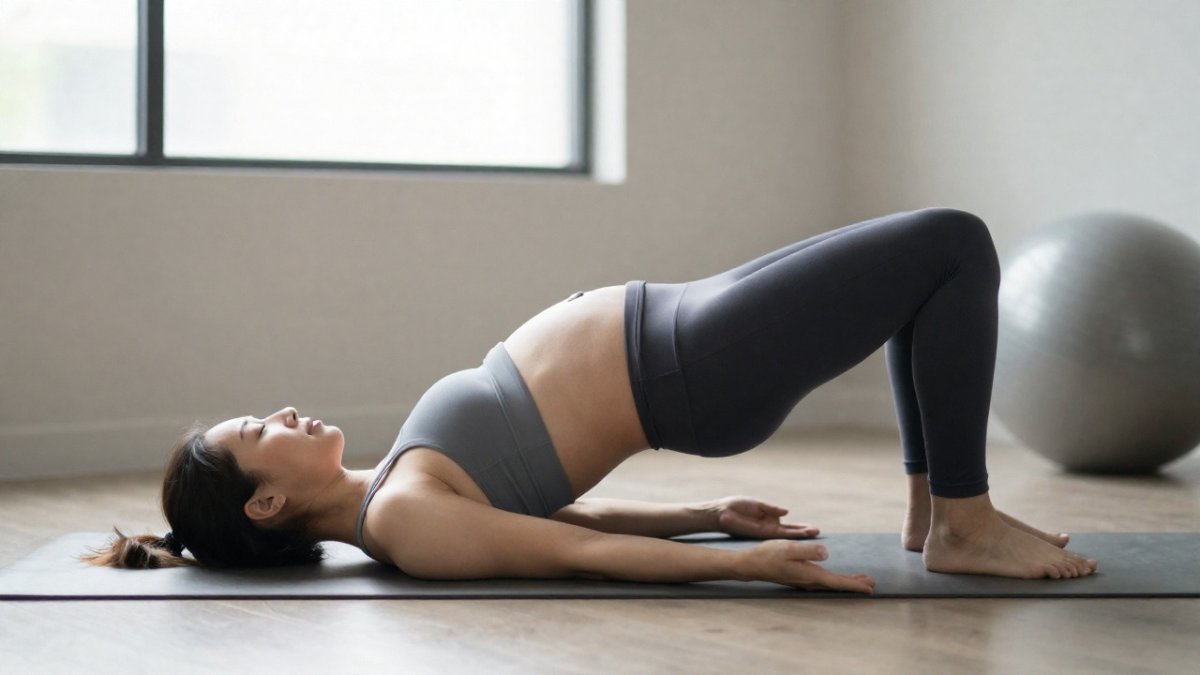
Pelvic Tilts and Core Coordination
Pelvic tilts gently activate the abdominal muscles and lumbar muscles without straining your back. Try this sequence:
- Lie on your back with knees bent, or sit tall on a stability ball
- Tilt your pelvis back and flatten your lower back
- Hold for a breath, then release
- Repeat 8-10 times, slowly
Pair each tilt with a calm breath to build muscle coordination.
Hip Mobility and Hip-Opening Movements
Hip mobility keeps the iliopsoas and rectus femoris from tightening as your posture shifts. These moves help:
- Low lunge: kneel on one knee, shift forward gently, hold 20 seconds
- Yogi squat: stand with feet wide, lower into a supported squat
- High lunge: step one foot forward, keep the back leg long
- Seated hip stretch: sit cross-legged and lean forward slowly
Keep each stretch within a comfortable range of motion.
A Trimester-by-Trimester Mobility and Posture Plan
A plan is only useful if you know what to do first, how long to hold, and when to progress. Use the structure below as a template and adjust to your comfort. Session length and frequency should be discussed with your care provider.
First Trimester: Build the Base
Goal: establish breathing, pelvic tilt control, and hip mobility before posture demands increase.
- Warm-up (3 minutes): walking in place, arm circles, gentle cat-cow on hands and knees
- Breathing (2 minutes): seated 360-degree breathing, 5 breaths in and out through the nose
- Pelvic tilts (2 sets of 8): lying on your back with knees bent or seated on a stability ball; hold each tilt for one breath
- Low lunge (2 sets of 20 seconds per side): kneel on one knee, shift forward gently, keep the back straight
- Seated hip stretch (2 sets of 20 seconds per side): cross-legged, lean forward from the hips
- Cool-down (2 minutes): side-lying rest with a pillow between the knees
Rest 30 to 45 seconds between sets. Progress by adding one set per week if you feel comfortable.
Second Trimester: Add Core and Hip Control
Goal: maintain core coordination as the abdomen grows and balance shifts.
- Warm-up (3 minutes): walking, shoulder rolls, standing hip circles
- Breathing with pelvic floor coordination (3 minutes): inhale to relax the pelvic floor, exhale to gently lift; 8 to 10 breaths
- Modified plank (2 sets of 15 to 20 seconds): on hands and knees or standing with hands on a counter; keep the ribs stacked over the pelvis
- Yogi squat (2 sets of 20 seconds): feet wide, hold a doorframe or chair for support
- Side-lying hip abduction (2 sets of 10 per side): keep the top hip stacked, lift the leg slowly
- Cool-down (3 minutes): child's pose with knees wide, then side-lying rest
Watch out: lying flat on your back becomes uncomfortable for many people after the first trimester. Switch to side-lying or seated variations rather than forcing the position.
Third Trimester: Stability and Balance
Goal: protect balance, reduce lumbar load, and keep hips mobile without straining.
- Warm-up (3 minutes): seated marching, ankle circles, supported standing hip circles
- Breathing and pelvic floor (3 minutes): side-lying or seated, focus on relaxing the pelvic floor on the inhale and gently lifting on the exhale
- Supported squat (2 sets of 20 seconds): hold a chair back or doorframe, feet wide, lower only as far as comfortable
- Side-lying hip opening (2 sets of 20 seconds per side): top knee lifts, keep the pelvis still
- Seated figure-4 stretch (2 sets of 20 seconds per side): sit tall, ankle over opposite knee, lean forward slightly
- Cool-down (3 minutes): side-lying rest with pillows between the knees and under the abdomen
Reduce hold times if you feel pressure or pain. Frequency matters more than intensity in the third trimester.
How to Progress and When to Hold Back
Progress one variable at a time: add a set, then add a few seconds to the hold, then increase range. Do not add sets and range in the same week. If you feel increased pelvic pressure, stop and return to the previous week's level. A common pattern is to feel fine during the session and sore the next day; use that next-day response as your guide.
Tracking Progress Without Overpromising
You can track comfort and function without claiming that exercise changes delivery outcomes. Use a simple 0-to-10 scale for pain before and after each session, note how long you can walk or stand comfortably, and record which movements you tolerated. Bring those notes to your provider or physiotherapist. Symptom relief and functional mobility are commonly discussed goals; discuss realistic expectations with your care provider.
Here is the trimester plan at a glance, from goals to cool-downs.
| Trimester | Goal | Key exercises | Watch out |
|---|---|---|---|
| First | Establish breathing, pelvic tilt control, hip mobility | Pelvic tilts, low lunge, seated hip stretch | Rest 30 to 45 seconds between sets |
| Second | Maintain core coordination as balance shifts | Modified plank, yogi squat, side-lying hip abduction | Lying flat on your back may become uncomfortable |
| Third | Protect balance, reduce lumbar load, keep hips mobile | Supported squat, side-lying hip opening, seated figure-4 stretch | Reduce hold times if you feel pressure or pain |
Prenatal Chiropractic Adjustments for Pelvic Alignment
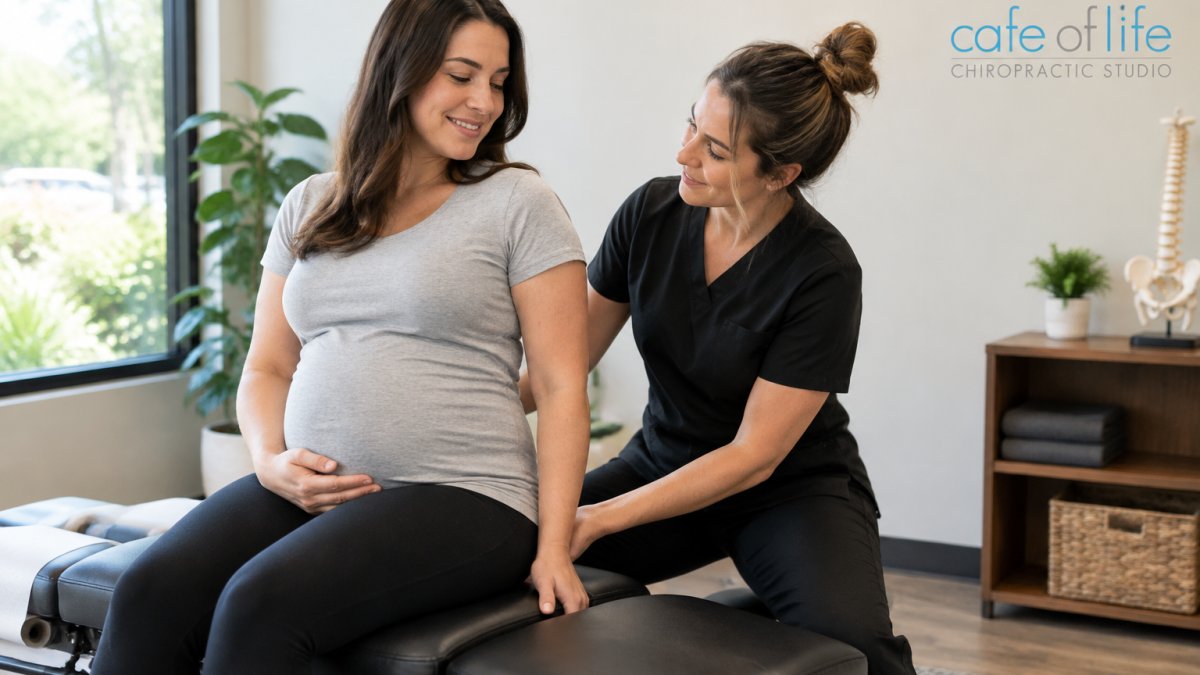
Prenatal chiropractic adjustments for pelvic alignment use gentle, controlled techniques to support comfort as your pelvis adapts. Many people ask whether chiropractic adjustments are safe during pregnancy. Speak with a qualified provider to discuss your individual situation.
We take a natural, drug-free approach and tailor each visit to your comfort. If lower back or hip pain is limiting your movement, book chiropractic care for pregnancy-related pain with our team.
Everyday Ergonomics for Sitting, Standing, and Sleeping
Daily posture habits do more for your back than any single exercise. Watch out: slouching in a soft chair for hours loads the lumbar spine and worsens back discomfort.
Try these habits:
- Sitting: feet flat, knees level with hips, lumbar support behind your lower back
- Standing: weight even on both feet, shoulders relaxed
- Sleeping: side-lying with a pillow between your knees
For a full desk setup routine, see our step-by-step desk posture guide.
How Often to See a Postpartum Chiropractor
There is no single schedule for everyone. How often to see a postpartum chiropractor depends on your symptoms, recovery, and goals. Visit frequency varies by individual, so discuss your recovery goals with a qualified professional.
Reassessment and plan adjustments are discussed with a qualified professional. Our postpartum recovery guide explains what to expect and when to start.
Pregnancy asks a lot of your body, and steady, guided care makes the difference. Ready to move more comfortably? Book a prenatal mobility assessment and get a plan built around you.
Frequently Asked Questions
How can I improve my posture during pregnancy?
Start with small, consistent changes: keep your ears over your shoulders when sitting, avoid locking your knees when standing, and use a lumbar support cushion in your chair. Add daily pelvic tilts and gentle hip-opening movements to reduce muscle tension. A prenatal physical therapy or chiropractic assessment can identify which areas need the most attention, and a trimester-by-trimester plan keeps your posture work progressive rather than sporadic.
Are there specific exercises to improve hip mobility while pregnant?
Yes. The yogi squat, low lunge, and high lunge are common hip-opening poses that target the iliopsoas, rectus femoris, and glutes. Hold each for 20 to 30 seconds and use a wall or chair for balance. Controlled movement matters more than depth, so stop before you feel pinching. Pair these with pelvic tilts and glute strengthening to keep your hips stable as your range of motion improves.
Is it safe to see a chiropractor for prenatal care in Canada?
Chiropractors in Canada are regulated health professionals, and many have additional training in prenatal care. Ask any provider about their credentials and prenatal experience before booking. If you have a high-risk pregnancy or complications, speak with your obstetric care provider first.
How often should I see a postpartum chiropractor?
Frequency depends on your symptoms, delivery history, and how your body is recovering. Some people benefit from weekly visits in the early postpartum weeks, while others do well with visits every two to four weeks. A chiropractor will assess your posture, pelvic alignment, and core function, then recommend a schedule. Reassess every few weeks so the plan stays matched to your recovery rather than fixed in advance.