
Can Poor Posture Cause Chronic Fatigue? What Science Says
Last Updated: October 31, 2026
Quick Summary
Yes, can poor posture cause chronic fatigue, poor posture is inefficient posture, forcing muscles to work harder all day and leaving you deeply tired by evening. Slumped sitting also restricts breathing and keeps the nervous system in a low-grade stress state, which drains energy. (Source: MedlinePlus on fatigue)
- Postural fatigue builds through the workday and usually improves with movement and posture breaks.
- Slumped posture compresses the ribcage, limiting the diaphragm and lowering oxygen intake.
- Chin tucks, shoulder blade squeezes, and wall angels target the stabilizers that tire first.
- Take a five-minute movement break every 45 minutes to test whether posture affects your energy.
- Post-exertional malaise, sore throat, and tender lymph nodes point away from posture and toward a medical workup.
Table of Contents
- How Poor Posture Drains Your Energy
- The Poor Posture Side Effects That Go Beyond Aching
- Muscles That Support Good Posture and Why They Tire First
- Breathing, Oxygen Flow, and the Fatigue Connection
- Posture Exercises for Back and Neck That Build Stamina
- Managing Chronic Fatigue When Posture Is Part of the Picture
- When Fatigue Deserves a Professional Assessment
- Your Next Step: A Posture and Energy Assessment
- Frequently Asked Questions
How Poor Posture Drains Your Energy
Can poor posture cause chronic fatigue? Yes, it can be a real contributor. Holding your body in a slumped position all day forces your muscles to work harder than they should, and that constant effort adds up to deep tiredness by evening. (Source: research on the physiological effects of prolonged sitting)
A desk worker who sits with rounded shoulders and a forward head for hours may find the body fighting gravity the whole time. For a concrete plan, see this step-by-step guide to fixing desk job posture tension. The result can be a heavy, foggy feeling that sleep does not fully fix.
The core issue is energy waste. Poor posture is inefficient posture. Your body spends fuel just to keep you upright, leaving less for everything else. (Source: Harvard Health Publishing on posture) Below, we explain why this happens and what you can do about it.
The Poor Posture Side Effects That Go Beyond Aching
Most people link bad posture to back pain. That is only part of the story. The poor posture side effects reach much further than a sore neck.
Here is what builds up over time:
- Tension headaches from tight neck and jaw muscles
- Shallow breathing that lowers oxygen intake
- Reduced focus as the brain gets less oxygen-rich blood
- Stiff shoulders that limit arm movement
- Low mood linked to a slumped, closed-off stance
One side effect stands out: chronic strain. Muscles held in a shortened position for hours never fully relax. They stay switched on, burning fuel even when you sit still. If neck tension is already part of your day, a step-by-step natural relief for neck tension routine can help you reset before the tightness turns into a daily drain.
Muscles That Support Good Posture and Why They Tire First
The muscles that support good posture sit deep in your body. They include the core, the spinal stabilizers, and the muscles along the back of the neck. These postural muscles are built for endurance, not power. They should hold you upright with little effort.
The problem is they tire fast when you ignore them. Hours of sitting weaken them. Then they struggle to hold your spine in line. The body leans on larger muscles to compensate, and those muscles are not designed for long, low-level work.
A common mistake is training only the showy muscles. Big back and chest workouts do not fix weak stabilizers. Small daily habits can matter as much as heavy lifting for posture.
Breathing, Oxygen Flow, and the Fatigue Connection
Slumped posture compresses your ribcage and pushes the diaphragm into a shortened position. That limits how deeply the diaphragm can pull air in. Less air per breath means lower oxygen saturation and reduced respiratory efficiency, and the link to fatigue is direct, because your brain and muscles need steady oxygen to make energy.
The mechanism is more specific than most people realize. When you slouch, the accessory breathing muscles in the neck and upper chest, the scalenes, sternocleidomastoids, and upper trapezius, take over work the diaphragm should be doing. These muscles are built for short bursts, not for eight hours of continuous breathing. They fatigue, tighten, and refer tension into the neck and jaw, which is one reason a slumped afternoon often ends in a tension headache rather than just a yawn.
There is a second layer that most posture articles skip: the neurological feedback loop. Your nervous system reads sustained postural strain as a low-grade stressor. The forward head position and rounded shoulders keep mechanoreceptors in the neck and upper back firing in a pattern the brain interprets as a threat signal. That nudges you toward a sympathetic, fight-or-flight, state: elevated resting heart rate, shallow chest breathing, and muscle tension that never fully releases. You are not in danger, but your body is spending energy as if you were. Over a workday, that adds up to the heavy, foggy tiredness that sleep does not fully clear.
Diaphragmatic breathing uses the large muscle under the ribs instead of the neck and shoulders, which can lower the work of breathing. A simple practice: sit tall, place one hand on your belly and one on your chest, inhale through the nose for a count of four so the lower hand rises first, then exhale for a count of six. Practising for a few minutes a day may help you notice a difference in how your neck and shoulders feel by evening.
To understand how spinal alignment and the nervous system connect to this process, read how chiropractic affects the nervous system.
Posture Exercises for Back and Neck That Build Stamina
These posture exercises for back and neck target the stabilizers that tire first. Do them slowly and stop if anything hurts. (Source: studies on the impact of breathing patterns on oxygen levels)
- Chin tuck: Pull your chin straight back, hold 5 seconds, repeat 10 times.
- Shoulder blade squeeze: Pinch the shoulder blades together, hold 5 seconds, repeat 10 times.
- Wall angels: Stand with your back to a wall and slide your arms up and down, 10 reps.
- Doorway chest stretch: Place your forearm on a door frame and lean forward gently, 20 seconds per side.
- Brugger relief position: Sit tall, open the chest, and tuck the chin, hold 20 seconds.
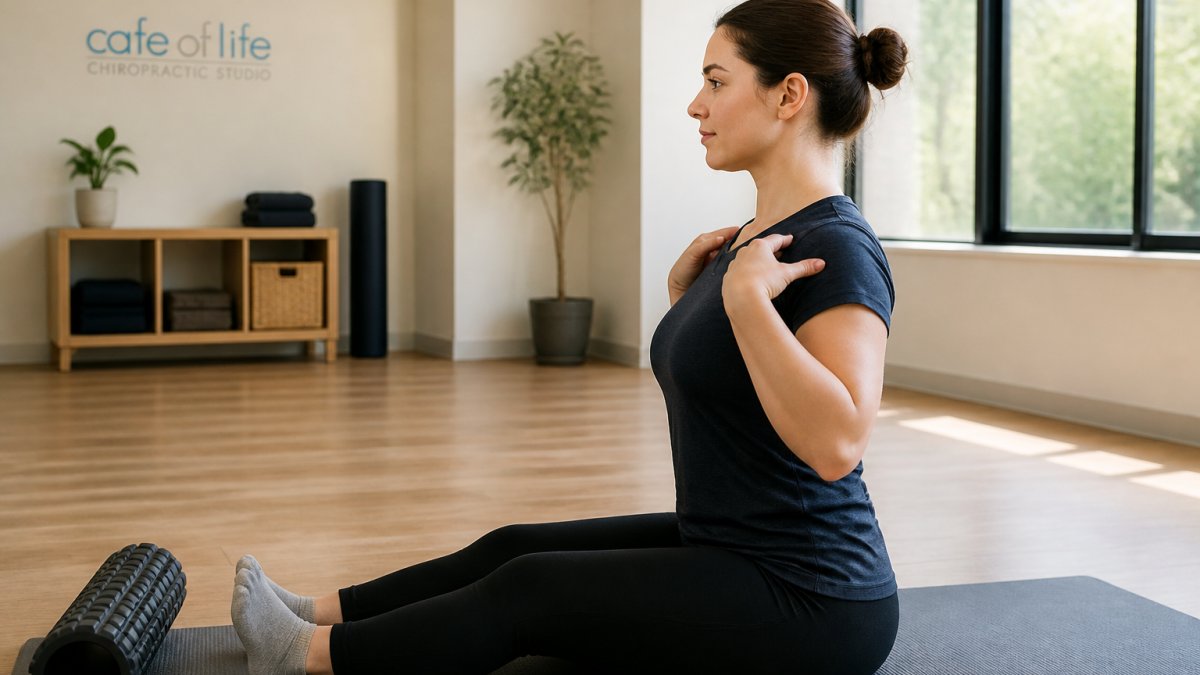
Stamina builds with consistency, not intensity. A few short sets, done most days, beat one long session per week. If you want realistic guidance on how often to work on correction and how long improvement takes, our guide on how often for posture correction lays out practical schedules.
Managing Chronic Fatigue When Posture Is Part of the Picture
Managing chronic fatigue starts with honest sorting. Posture-related tiredness is not the same as Chronic Fatigue Syndrome (CFS/ME), and confusing the two can delay the care you actually need. Postural fatigue is mechanical: it improves when you fix the load. CFS/ME is a complex, multi-system medical condition that requires a doctor's assessment and ongoing management. (Source: CDC overview of ME/CFS) Distinguishing between these origins allows for more effective fatigue management solutions that address the specific mechanical or systemic drivers of your exhaustion.
A simple way to tell them apart:
| Sign | Postural Fatigue | CFS/ME |
|---|---|---|
| Onset | Builds through the workday | Often follows minimal activity |
| Relief | Improves with movement and posture breaks | Worsens after exertion (post-exertional malaise) |
| Sleep | Usually restores energy | Often does not |
| Pattern | Predictable, tied to sitting | Unpredictable, systemic |
| Other symptoms | Neck and shoulder tension, headaches | Unrefreshing sleep, cognitive fog, sore throat, tender lymph nodes |
The key differentiator is post-exertional malaise, the hallmark of CFS/ME, where even light activity triggers a crash that can last 24 hours or more. (Source: CDC on post-exertional malaise) Postural fatigue does not do that. If a short walk or a load of laundry leaves you flattened the next day, that pattern points away from posture and toward a medical workup.
A practical self-triage you can run this week:
- Track the timing. Note when your energy dips. If it clusters two to four hours into desk work and lifts after a walk or a stretch break, posture is a likely contributor.
- Test the reset. Take a five-minute movement break every 45 minutes for three days. If your afternoon energy improves, the mechanical load was part of the problem.
- Check the recovery. If a good night's sleep restores you, postural fatigue is more likely. If you wake unrefreshed most days, escalate.
- Log the non-postural symptoms. Sore throat, tender lymph nodes, and cognitive fog that do not track with desk hours are reasons to see a doctor, not a posture coach.
If your tiredness tracks with desk hours, posture is likely a factor. Build movement breaks into your day, set up your workspace well, and strengthen your core. These steps may help reduce the load on your body over time. But if the pattern does not fit, do not force it, get the medical assessment first.
When Fatigue Deserves a Professional Assessment
Some fatigue needs more than a posture fix. See a health professional if you notice any of these:
- Tiredness that lasts for weeks despite good sleep
- Fatigue with unexplained weight loss or fever
- Shortness of breath at rest
- Numbness, weakness, or pain that spreads down an arm or leg
- Tiredness that gets worse after light activity
These signs can point to conditions that need proper testing, as outlined by the NHS guidance on tiredness and fatigue. A health professional can help you decide whether a medical workup is needed first. Knowing when to get help protects you from missing something serious.
Your Next Step: A Posture and Energy Assessment
If your energy dips every afternoon and your posture has slipped, the two may be linked. A focused assessment can show where your body is working too hard and where it needs support. You can learn more about chiropractic care for poor posture in London, ON and book an appointment. Cafe of Life Chiropractic Studio offers a natural, drug-free approach focused on mobility, posture, and overall well-being.
The studio supports people at every stage of life, with a focus on mobility, posture, and overall well-being.
Ready to learn more? Schedule your first visit today.
Frequently Asked Questions
Can poor posture cause chronic fatigue?
Poor posture can contribute to persistent tiredness, though it is rarely the only cause. Slumping forces postural muscles into prolonged contraction, which raises energy expenditure and can leave you feeling drained by mid-afternoon. Shallow breathing from a collapsed ribcage also lowers oxygen saturation. That said, chronic fatigue has many possible drivers, including sleep disorders, thyroid issues, and anemia, as the Mayo Clinic notes, so persistent exhaustion should be assessed by a health professional rather than blamed on posture alone.
Which muscles that support good posture should I strengthen first?
Start with the deep neck flexors, lower trapezius, rhomboids, and core stabilizers. These muscles hold the head and shoulders in line and keep the spine stacked without constant effort. Weakness here lets the head drift forward, which increases vertebral load and forces other muscles to compensate. Simple chin tucks, wall angels, and dead bugs target these groups. A chiropractor or physiotherapist can identify which muscles are underactive versus overactive in your specific case.
How often should I do posture exercises for back and neck pain?
Most people benefit from short sessions of five to ten minutes, done daily or at least four times a week. Consistency matters more than duration. Pair them with movement breaks every 30 to 45 minutes during desk work, since prolonged sitting stiffens the thoracic spine and undoes the gains. If an exercise increases pain or numbness, stop and get it checked. Progress should feel gradual, with less stiffness and better stamina over several weeks.
How is postural fatigue different from chronic fatigue syndrome?
Postural fatigue is a mechanical, activity-related tiredness that improves with rest, position changes, and strengthening. Chronic fatigue syndrome (ME/CFS) is a distinct medical condition, as defined by the CDC, marked by profound exhaustion lasting six months or more, unrefreshing sleep, and post-exertional malaise, where symptoms worsen after activity. Posture work may ease discomfort in ME/CFS but will not treat the underlying condition. If fatigue is severe, persistent, or worsens after mild exertion, see a physician for proper assessment.