
Gentle Adjustments for Sensitive Patients: A Guide
Table of Contents
- What Makes an Adjustment Gentle?
- Low-Force Chiropractic Techniques That Work for Sensitive Bodies
- Chiropractic Activator Tool Benefits for Anxious or Pain-Sensitive Patients
- What to Expect at a Chiropractic Appointment When You Need a Gentler Approach
- Who Benefits Most From Gentle Adjustments
- Caring for Your Body After a Gentle Adjustment
- Frequently Asked Questions
Last Updated: September 29, 2026
What Makes an Adjustment Gentle?
A gentle adjustment is a low-force spinal correction that uses controlled pressure instead of a quick manual thrust, making it suitable for sensitive patients. The goal stays the same: restore spinal joint mobility and support nerve function. The method changes. (Source: Canadian Chiropractic Association patient resources)
The Difference Between Manual Thrust and Low-Force Care
Traditional manual thrust relies on a high-velocity, low-amplitude motion. The practitioner moves a joint quickly through a small range. That speed is what creates the audible joint cavitation, the "pop" most people associate with chiropractic care.
Low-force care works differently:
- Pressure builds slowly instead of suddenly
- The spinal segment moves through a smaller arc
- Soft tissue gets time to relax before any correction
- The patient stays in control of the pace
Canadian Chiropractic Association patient resources
Low-Force Chiropractic Techniques That Work for Sensitive Bodies
Low-force chiropractic techniques cover a family of methods, each suited to different bodies and different comfort levels. A common approach is to start with the lightest option and adjust from there. Your practitioner should explain each technique before using it.
The main options include:
- Instrument-assisted adjusting - a hand-held tool delivers a controlled pulse
- Upper cervical specific work - precise, light contact at the top of the spine
- Toggle recoil - a gentle table drop replaces the manual thrust
- Soft tissue release - muscle work before any joint correction
- Positional release - the body settles into a comfortable position while tension eases
Instrument-Assisted Adjusting
Instrument-assisted adjusting uses a small spring-loaded tool to deliver a quick, targeted pulse to a spinal segment. The peak force is far lower than a manual thrust, and the contact point is about the size of a fingertip.
- Patients with fibromyalgia or widespread sensitivity
- Older adults with fragile joints
- Children and infants
- Anyone recovering from recent injury or surgery
Upper Cervical and Toggle Recoil Methods
Upper cervical techniques focus on the top two vertebrae, where the spine meets the skull. This area carries a lot of neurological traffic, so precision matters more than force. Toggle recoil uses a specialized table. The practitioner applies a light, quick contact while the table drops away, removing the need for a hard push.
Chiropractic Activator Tool Benefits for Anxious or Pain-Sensitive Patients
The Activator tool is a well-known instrument for low-force care, and its benefits can go beyond the physical. For anxious patients, the psychological comfort can matter as much as the mechanical result. There is no twisting, no sudden movement, and no sound the patient has to brace against.
Why 'Adjustment Anxiety' Is Real and Worth Naming
A common pattern among sensitive patients can be adjustment anxiety: a learned flinch response built from past pain, medical procedures, or simply the cultural expectation that a chiropractor will 'crack' your neck. That expectation can be powerful. It can raise muscle tension before the appointment even starts, which in turn can make any adjustment harder to perform comfortably.
What the Activator Actually Does
The Activator is a small, spring-loaded instrument that delivers a controlled, high-speed but very low-force pulse to a specific spinal segment. The contact point is roughly the size of a fingertip. The peak force is a fraction of what a manual thrust produces, and the pulse lasts only milliseconds. Because the impulse is so brief, the surrounding muscles rarely have time to guard against it.
The main benefits include:
- Controlled pressure that stays consistent from visit to visit
- No joint cavitation, so nothing to flinch at
- Predictable sensation, patients often describe it as a light tap rather than a push
- Fast sessions that work for tight schedules
- Gentle handling of musculoskeletal strain
- A calm first experience for patients new to chiropractic
The Psychological Payoff
For patients with anxiety around physical treatment, the Activator offers something a manual adjustment cannot: predictability. You know what the tool will feel like before it touches you. There is no rotation, no sudden drop, no audible release to brace against. Over a few visits, that predictability often replaces the flinch response with a neutral or even relaxed one.
Canadian Chiropractic Association patient resources
What to Expect at a Chiropractic Appointment When You Need a Gentler Approach
Your first visit should feel like a conversation, not a procedure. A good practitioner asks about your history, your pain, and your previous experiences with bodywork before anyone touches your spine.
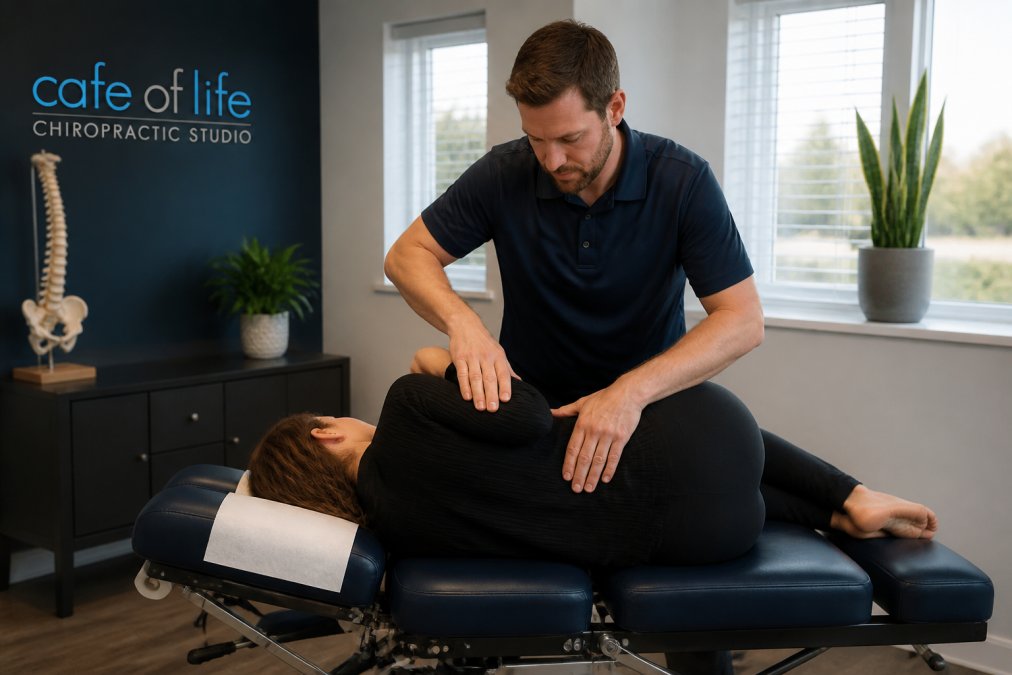
Here is the typical flow:
- Intake and history - what hurts, how long, what you have already tried
- Assessment - posture, range of motion, and a hands-on check
- Technique discussion - which method fits your body and why
- The adjustment itself - usually a few minutes, often less
- Aftercare notes - what to do in the next 24 to 48 hours
Who Benefits Most From Gentle Adjustments
Gentle adjustments suit anyone who wants spinal care without a forceful thrust. Some groups benefit more than others. Pregnant patients dealing with lower back pain often find low-force care easier to tolerate than manual work. New parents bringing in a baby with colic or a structural limitation like torticollis need a very light touch. Athletes recovering from injury often want controlled pressure rather than aggressive manipulation.
Other good candidates include:
- People with fibromyalgia or chronic pain conditions
- Older adults managing joint discomfort and stiffness
- Office workers with posture-related neck and shoulder tension
- Anyone with anxiety around physical treatment
Caring for Your Body After a Gentle Adjustment
Post-adjustment care for sensitive bodies is simpler than most people expect, but it is not identical for everyone. The main job is to let the correction settle without undoing it. What that looks like depends on your body and your condition.
The First 24 to 48 Hours
A common pattern is that sensitive patients may respond well to a low-input recovery window. That means:
- Drink water through the rest of the day
- Move gently: a short walk beats a hard workout
- Avoid heavy lifting for 24 hours
- Skip intense stretching of the area that was adjusted
- Note how you feel so you can report back next visit
Heat or Ice? It Depends on What You Feel
Most generic aftercare advice says 'apply ice' or 'apply heat' without explaining the choice. For sensitive patients, the distinction matters.
- Warmth suits muscles that feel tight, guarded, or stiff. A warm shower, a heating pad on low for 15 to 20 minutes, or a warm compress over the area is usually enough. Warmth encourages blood flow and helps soft tissue release.
- Cold suits areas that feel inflamed, swollen, or acutely irritated. A cold pack wrapped in a thin cloth for 10 to 15 minutes can calm a reactive spot. Never place ice directly on skin.
- Alternating can help some people with chronic pain conditions, but it is best discussed with your practitioner rather than guessed at.
Condition-Specific Notes
Different bodies need different recovery rhythms. A few common patterns:
- Fibromyalgia or widespread sensitivity: shorter sessions, more frequent visits, and a lower tolerance for cumulative input. Many patients do better with one technique per visit rather than a full protocol.
- Osteoporosis or fragile joints: avoid any home movement that involves twisting or loaded bending for the first day. Gentle walking and light range-of-motion are usually fine.
- Pregnancy: side-lying rest, hydration, and avoiding prolonged standing in the first few hours after a visit tend to work well. Ligament laxity means the body may hold a correction differently than it would outside pregnancy.
- Post-injury or post-surgical: follow the surgeon's or physician's restrictions first. A gentle adjustment does not override a healing timeline.
When to Check In With Your Practitioner
Most post-adjustment sensations settle within a day or two. Contact your practitioner if you notice:
- Pain that is sharper or more localized than before the visit
- Numbness, tingling, or weakness that is new
- Symptoms that worsen rather than ease over 48 hours
Aftercare for sensitive bodies is less about doing more and more about doing less, on purpose. Hydrate, move gently, choose warmth unless you have a clear reason to use cold, and give the correction a full day before you judge how it worked.
Frequently Asked Questions
Are gentle adjustments safe for sensitive individuals?
Gentle adjustments use controlled, low-force pressure rather than forceful manual thrusts. This makes them suitable for people with fibromyalgia, chronic pain, anxiety, osteoporosis, or anyone who finds traditional adjustments uncomfortable. A qualified chiropractor will assess your health history and adapt the technique to your tolerance level. No approach is risk-free, so discuss any concerns with your practitioner before treatment begins.
Is gentle chiropractic as effective as traditional methods?
Low-force techniques, such as the Activator Method, can be effective in improving spinal joint mobility and reducing pain for many patients. Effectiveness depends on your specific condition, the skill of the practitioner, and how consistently you follow the care plan. For sensitive patients, a gentler approach may be preferred as it can help avoid the muscle guarding and tension that forceful adjustments might trigger.
What are low-force chiropractic techniques?
Low-force chiropractic techniques include instrument-assisted adjusting, upper cervical specific methods, toggle recoil, and gentle table-assisted positioning. These approaches deliver a controlled, measured force to a specific spinal segment rather than using a high-velocity manual thrust. They are designed to restore vertebral alignment and joint mobility while keeping patient comfort central to the process.
What should I expect during my first gentle chiropractic visit?
Your first visit typically includes a health history review, a physical and neurological assessment, and a discussion of your comfort level and goals. The chiropractor will explain which low-force technique suits your body and may perform a trial adjustment. You can ask questions at any point. Many patients feel relief or mild soreness afterward, similar to what you might feel after light exercise.
Chronic pain and sensitivity should not keep you from getting care. At Cafe of Life Chiropractic Studio, we offer natural, drug-free chiropractic care in a nurturing setting, with specialized support for maternal health, pediatric development, and athletic recovery. Our holistic focus on mobility, posture, and well-being means your first visit starts with listening, not forcing. Schedule your first visit today and find out how gentle care can fit your body.