Chiropractic for Sports Injury Recovery: A 2026 Guide
Table of Contents
- How Chiropractic Care Fits Into Sports Injury Recovery
- What to Expect at a Sports Injury Appointment
- Common Sports Injuries Treated and the Evidence Behind It
- Chiropractic Care for Tendonitis and Soft-Tissue Injuries
- Sports Injury Rehabilitation Exercises That Support Recovery
- Return to Sport After Injury: Testing and Load Management
- Sports Injury Prevention for Athletes
- Red Flags, Referral Pathways and Safety
- Frequently Asked Questions
Last Updated: October 21, 2026
How Chiropractic Care Fits Into Sports Injury Recovery
Chiropractic for sports injury recovery works best as one part of a coordinated plan, not a standalone cure.
A sports injury is damage to muscle, tendon, ligament, bone or joint from training or competition. Chiropractic care is a hands-on approach that assesses movement and uses manual techniques to improve joint mobility and muscle function.
Where does it fit? A Cochrane review of manual therapy for musculoskeletal pain found manual therapy can help with pain and function in some conditions, though evidence quality varies by injury type.
For athletes, the practical benefit is movement. A stiff ankle or locked-up thoracic spine changes how you run, land and cut.
What to Expect at a Sports Injury Appointment
A first appointment is mostly assessment: a detailed history, a physical examination, and often a movement screen before any treatment. If a practitioner adjusts you in the first five minutes without asking how the injury occurred, that is a warning sign.
Movement Assessment and History
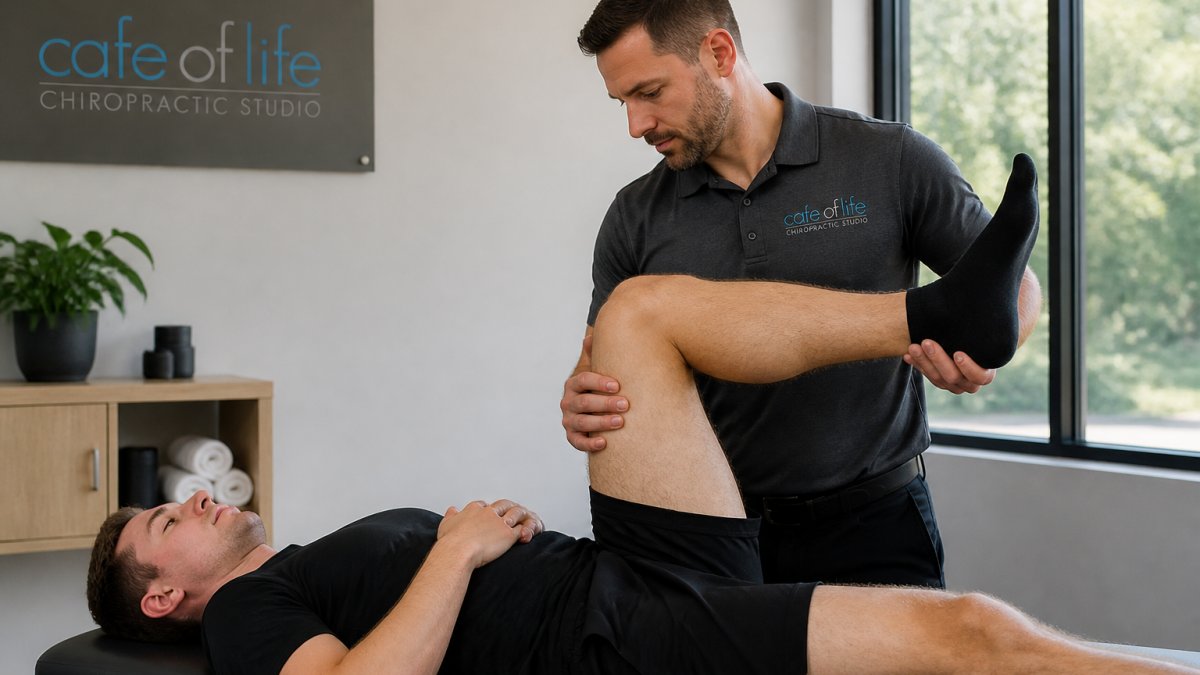
The history covers mechanism of injury, training load, previous injuries, and what worsens the pain. Then comes a movement assessment: watching you squat, hinge, balance, and walk, plus specific joint and muscle tests, to decide whether the problem is local or a compensation pattern.
Manual Adjustments and Joint Mobilization
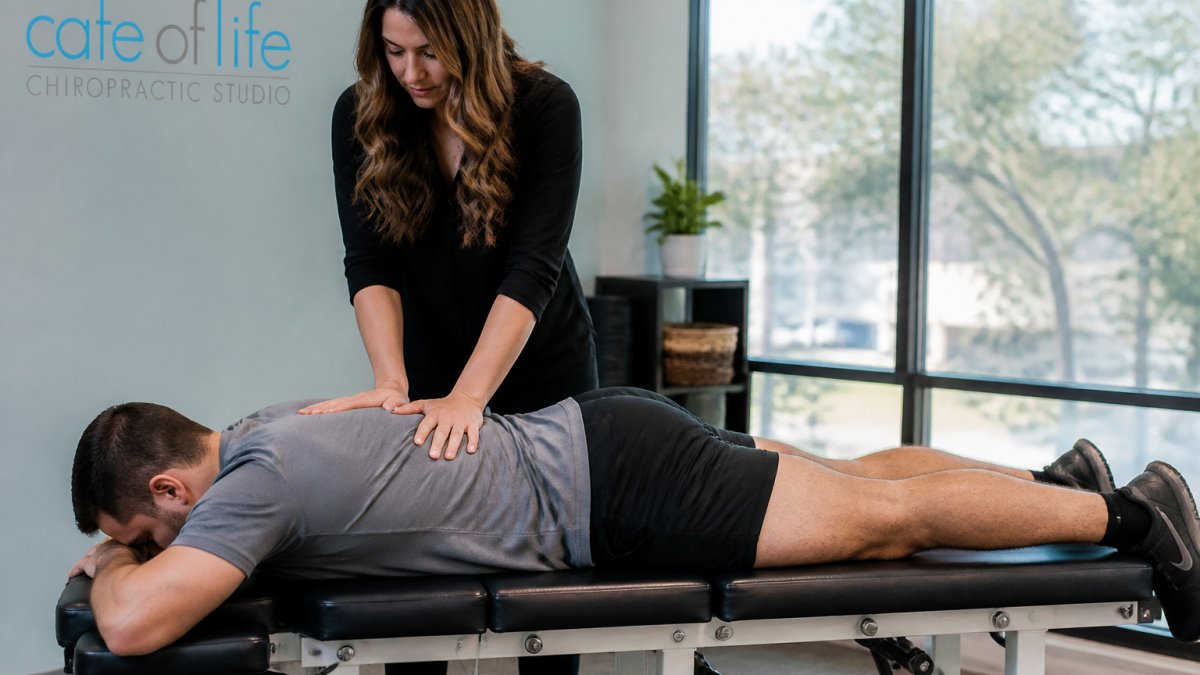
Manual adjustments are controlled, precise movements applied to a joint. Joint mobilization is a gentler, graded version of the same idea. Both aim to restore motion in a joint that has become restricted after injury.
Common Sports Injuries Treated and the Evidence Behind It
The injuries most often seen are sprains, strains, tendinopathies, and joint restrictions after immobilization, ankle sprains, hamstring strains, patellofemoral knee pain, and adductor injuries among them. Each has a different evidence base, and honesty about that matters.
Here is where we part ways with a lot of clinic marketing: chiropractic care is not proven to speed tissue healing itself. The National Institute for Health and Care Excellence guidance on low back pain recommends manual therapy only alongside exercise, not instead of it. A Cochrane review of manual therapy for musculoskeletal pain reaches a similar conclusion for several musculoskeletal conditions, with the caveat that evidence quality varies by injury type.
Below are practical, phased examples for four common presentations, including criteria for progressing activity rather than a generic recovery claim. These are illustrative frameworks, not a substitute for individual assessment.
Ankle Sprain
- Phase 1 (acute, roughly days 1-7): protect the joint, control swelling, restore pain-free range of motion with gentle ankle pumps and circles. Manual therapy may help restore dorsiflexion once swelling settles. Do not force weight-bearing through pain.
- Phase 2 (early loading, roughly weeks 1-3): progressive weight-bearing, calf raises, single-leg balance, and low-amplitude joint mobilization. Progress when swelling is stable and walking is pain-free.
- Phase 3 (strength and control, roughly weeks 3-6): full-range calf strengthening, lateral hops, and change-of-direction drills. Progress when single-leg balance is symmetric and hop tests are pain-free.
Hamstring Strain
- Phase 1: protect against re-injury, avoid aggressive stretching, and begin isometric hamstring holds at low intensity. Manual therapy may address hip or pelvic restriction that alters running mechanics.
- Phase 2: eccentric hamstring loading (for example, Nordic curl progressions) and hip extension strength. Progress when walking and jogging are pain-free.
- Phase 3: running progression from jog to stride to sprint, with strength within a close margin of the uninjured side. Progress when sprinting is pain-free and strength is symmetric.
Patellofemoral Knee Pain
- Phase 1: reduce aggravating load, restore quadriceps and gluteal activation, and address hip or ankle restriction that changes knee tracking. Manual therapy may improve comfort enough to exercise.
- Phase 2: controlled strengthening through full range, single-leg squats, and step-downs. Progress when daily activities are pain-free.
- Phase 3: plyometrics and running progression. Progress when pain remains stable during and after loading.
Adductor Injury
- Phase 1: relative rest, isometric adductor holds, and gentle hip mobility. Manual therapy may address hip or pelvic restriction.
- Phase 2: progressive adductor strengthening (for example, Copenhagen adduction progressions) and hip stability work. Progress when walking and light jogging are pain-free.
- Phase 3: change-of-direction and kicking or skating drills specific to the sport. Progress when strength is symmetric and sport-specific movement is pain-free.
| Injury | What Chiropractic Care May Help | What It Won't Do |
|---|---|---|
| Ankle sprain | Restore mobility after swelling settles | Repair a torn ligament |
| Hamstring strain | Reduce stiffness, improve hip motion | Replace graded loading |
| Knee pain | Improve joint mobility and tracking | Cure structural damage |
| Adductor injury | Address hip and pelvic restriction | Heal the muscle for you |
Chiropractic Care for Tendonitis and Soft-Tissue Injuries
Chiropractic care for tendonitis focuses on the joints and muscles around the irritated tendon, not the tendon itself. Tendons respond to progressive load, so hands-on work is a supporting act. Be skeptical of anyone promising to "fix" tendonitis with adjustments alone.
Soft-tissue therapy, whether instrument-assisted or hands-on, can reduce surrounding muscle guarding and improve comfort enough to do the loading work that actually changes tendon capacity. The Canadian Physiotherapy Association resource on tendinopathy makes the same point: load management is the core treatment.
Sports Injury Rehabilitation Exercises That Support Recovery
Sports injury rehabilitation exercises do the heavy lifting that hands-on care cannot. Adjustments create a window of better movement; exercise builds the capacity to keep it. Skip the exercises and the restriction returns.
A practical progression we use:
- Early stage: isometric holds, gentle range-of-motion work, pain-free movement
- Mid stage: controlled strengthening through full range, single-leg balance
- Late stage: plyometrics, change-of-direction drills, sport-specific loading
The rule is simple: progress load only when the current stage is pain-free and movement quality holds. A common mistake is jumping from gentle strengthening straight to sprinting because the pain settled.
Return to Sport After Injury: Testing and Load Management
Return to sport after injury should be decided by testing, not a calendar or how you feel on a good day. Feeling ready and being ready are different things, and the gap is where re-injury lives.
Use objective criteria before returning:
- Pain-free full range of motion on both sides
- Strength within a close margin of the uninjured limb
- Passed single-leg hop and balance tests
Load management means increasing training volume and intensity in steps, watching for a flare that lasts more than a day. A BJSM consensus statement on return to sport frames return to sport as a continuum with shared decision-making, not a single clearance date.
Sports Injury Prevention for Athletes
Injury prevention comes down to movement quality, load management, and addressing small restrictions before they become compensations. Athletes who move well and progress load sensibly get injured less often, regardless of hands-on care.
Here is what a practical, measurable approach looks like.
Load Management With Concrete Metrics
- Track acute-to-chronic workload. A common rule of thumb is to keep the acute load (this week) within roughly 1.3 times the chronic load (the rolling four-week average). Spikes above that are associated with higher injury risk in many team sports, though the evidence is not uniform across all injuries.
- Limit week-to-week volume increases. A common guideline is no more than about a 10 percent increase in training volume per week. This is a heuristic, not a law, but it prevents the weekend-heroics pattern.
- Monitor soreness and fatigue. A simple daily check-in on soreness, sleep, and energy can flag a load problem before an injury occurs. A flare lasting more than 24 hours is a signal to pull back.
Movement Screening That Actually Informs Training
- Single-leg balance and hop tests. Asymmetry between sides is a practical flag for strength or control deficits, particularly after a previous ankle or knee injury.
- Overhead squat and hinge assessment. These reveal hip, ankle, and thoracic restrictions that change how load is distributed.
- Calf and hip strength testing. Weak calves and hips are common contributors to lower-limb injuries in running and cutting sports.
Strength Work That Matters
- Hips, calves, and core. These are the foundations of safer movement. Prioritize hip abduction and extension, calf raises through full range, and anti-rotation core work.
- Eccentric hamstring loading. Nordic curl progressions are a well-established way to reduce hamstring strain risk in field and running sports.
- Adductor strengthening. Copenhagen adduction progressions are commonly used to reduce groin injury risk in sports with cutting and kicking.
Recovery Basics No Adjustment Can Replace
- Sleep. Most athletes need roughly seven to nine hours. Sleep debt impairs reaction time and tissue recovery.
- Nutrition and hydration. Adequate protein and energy intake support tissue repair; under-fueling is a common and under-recognized risk factor.
- Deload weeks. Planned reductions in load every few weeks help the body adapt rather than accumulate fatigue.
Posture matters too. A desk-bound athlete often arrives at training with restricted hips and a stiff mid-back, changing biomechanics under load. A short daily mobility routine for the hips and mid-back is a practical countermeasure.
Red Flags, Referral Pathways and Safety
Red flags mean stop and see a physician, not a chiropractor. Severe swelling, deformity, inability to bear weight, numbness, progressive weakness, night pain that wakes you, fever, or a history of cancer all warrant medical assessment first.
Certain conditions, some fractures, infections, and unstable spinal conditions, mean manual adjustments are not appropriate. Tell your practitioner about any diagnosed condition, medication, or recent surgery. Chiropractic care carries small but real risks, and honest consent means discussing them.
What to expect if referral is needed: your practitioner should communicate with your physician or physiotherapist rather than working in isolation.
Sports injury recovery rarely follows a straight line, and the athletes who recover best have a plan that addresses movement, strength, and load together.
Frequently Asked Questions
Is chiropractic care good for athletes?
Chiropractic care can be a useful part of an athlete's recovery and maintenance plan. A sports chiropractor assesses movement, joint mobility and muscle function, then uses manual adjustments and mobilization alongside rehabilitation exercises. Research on spinal manipulation for low back pain, such as reviews from the Cochrane Library, shows modest short-term pain relief for some people. For athletes, the practical value often comes from combining care with a structured return-to-sport plan and load management, not from adjustments alone. Anyone with a suspected fracture, severe swelling or neurological symptoms should see a physician first.
Can a chiropractor do anything for tendonitis?
A chiropractor can support chiropractic care for tendonitis by addressing surrounding joint stiffness, muscle tightness and movement patterns that may place extra load on the tendon. Treatment often includes soft-tissue therapy, joint mobilization and progressive loading exercises. Tendonitis usually needs a loading program over weeks, so hands-on care works best alongside rehabilitation. If pain is sharp, worsening or accompanied by swelling and weakness, get a medical assessment to rule out a tear. A chiropractor should coordinate with your physician or physiotherapist rather than work in isolation.
When should an athlete seek medical care instead of chiropractic treatment?
Seek medical care first for a suspected fracture, inability to bear weight, severe or worsening swelling, numbness, weakness, or a joint that gives way. These are red flags that need imaging or urgent assessment. Chiropractic care is not appropriate for unstable fractures, certain inflammatory conditions or active infection. If you have osteoporosis, a bleeding disorder or are taking blood thinners, tell your practitioner before any manual treatment. A qualified chiropractor will refer you when findings fall outside their scope, and that referral pathway is a sign of good practice rather than a limitation.
Can chiropractic care be combined with physiotherapy or rehabilitation exercises?
Yes, and it often should be. Manual adjustments and joint mobilization can improve short-term comfort and mobility, while sports injury rehabilitation exercises build strength, flexibility and tissue tolerance. A combined plan might include soft-tissue therapy and spinal adjustments early on, then progress to loaded exercises and return-to-sport testing. Tell each provider what the other is doing so the plan stays coordinated. There is no single rule that fits every athlete, so the mix depends on your injury, stage of healing and sport demands.
How does a chiropractor assess a sports injury?
A sports injury assessment typically starts with a history of the injury, training load and previous problems, followed by observation of posture and movement. The chiropractor may test range of motion, joint mobility, muscle strength and specific movements related to your sport. Orthopedic tests help identify structures involved. If findings suggest a fracture, ligament tear or other condition outside chiropractic scope, you will be referred for medical imaging or a physician review. The assessment guides whether manual care, rehabilitation exercises or a referral is the right next step.