Chiropractic for Scoliosis and Posture: 2026 Guide
Table of Contents
- What Scoliosis Means for Your Spine and Posture
- How Chiropractic for Scoliosis and Posture Works
- Chiropractic Scoliosis Treatment Effectiveness: What the Evidence Shows
- Posture Correction Exercises for Scoliosis You Can Do at Home
- Ergonomic Tips for Scoliosis Patients at Work and Home
- Combining Chiropractic Care With Bracing and Surgery
- Frequently Asked Questions
Last Updated: September 20, 2026
What Scoliosis Means for Your Spine and Posture
Scoliosis is a three-dimensional spinal deformity in which the vertebrae rotate and shift sideways, producing a lateral curve of 10 degrees or more on the Cobb angle. It changes how the spine bears load, which is why posture, shoulder height, and rib position often shift alongside the curve.
Types and Diagnosis: Pediatric vs. Adult Scoliosis
The two groups need different conversations. Adolescent idiopathic scoliosis is the most common form and is typically monitored while the skeleton is still growing (pubmed.ncbi.nlm.nih.gov). Adult scoliosis is usually a curve that was present earlier and progressed, or one that developed from degenerative changes in the discs and joints.
| Type | Typical Age at Detection | Primary Concern | Common Approach |
|---|---|---|---|
| Pediatric/adolescent | 10-18 years | Progression during growth | Monitoring, bracing, exercise |
| Adult degenerative | 40+ years | Pain, nerve symptoms, function | Pain management, movement therapy |
| Adult residual | Any adult age | Progression of an old curve | Monitoring, conservative care |
How Chiropractic for Scoliosis and Posture Works
Chiropractic care does not straighten a scoliotic curve, and any provider who promises that is overselling. What it can do is address the joint restriction, muscle imbalance, and postural strain around a curve, which often improves comfort and how well the surrounding joints move.
Manual Adjustments and Soft Tissue Work
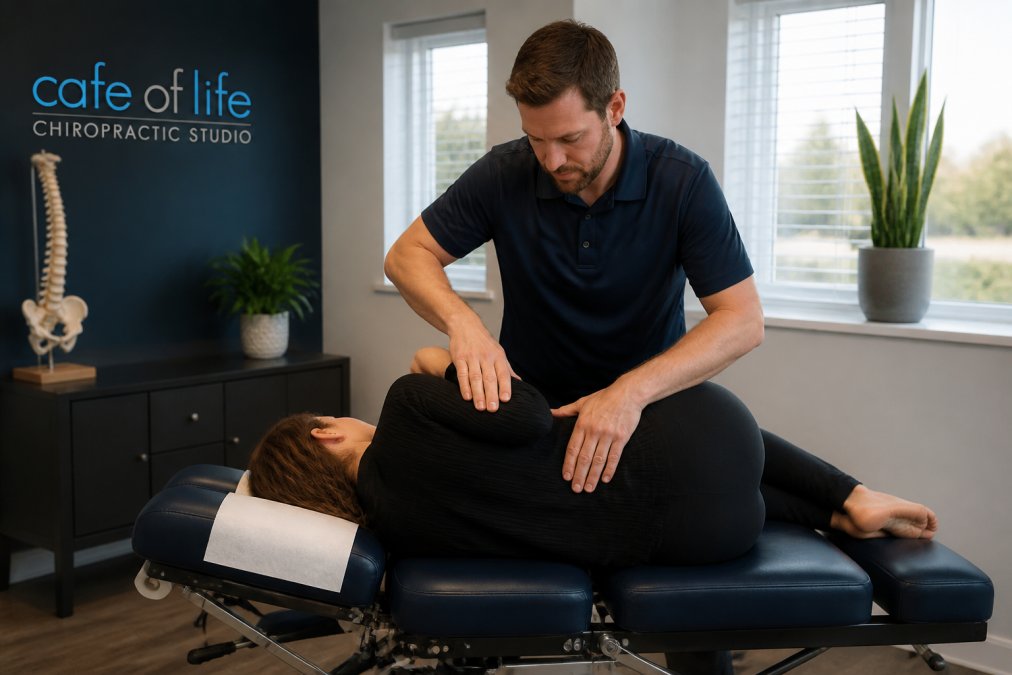
Manual adjustments target restricted segments, aiming to restore mobility rather than force the spine into a different shape. Soft tissue work, including myofascial release and targeted massage, addresses the muscular guarding around a long-standing curve.
Chiropractic Scoliosis Treatment Effectiveness: What the Evidence Shows
Scoliosis management is a long game, and conservative care is judged on function and comfort, not curve correction alone. Research generally supports conservative care for symptom relief and mobility, while evidence for structural curve change remains limited, a distinction that tells you what to expect and measure.
- Pain and function: The strongest support for conservative care sits here. Manual therapy and exercise are studied for their effect on pain intensity, sitting tolerance, and daily activity, usually the measures that move first.
- Mobility and range of motion: Trunk rotation, side-bending, and forward flexion are tracked because they respond to treatment and correlate with how the spine tolerates load.
- Curve progression: The evidence is weakest here for chiropractic alone. The Cobb angle is the standard radiographic marker, and conservative care is not generally shown to reverse it. The realistic goal is stabilization and monitoring, not correction.
- Quality of life: Sleep, clothing fit, self-image, and activity participation are legitimate outcomes, often the reason someone seeks care at all.
Measuring Outcomes: Cobb Angle, Mobility, and Pain Scores
Tracking outcomes separates a real treatment plan from guesswork. The Cobb angle, measured from imaging, is the standard way to gauge whether a curve is stable, improving, or progressing. It is not a daily metric, so it is checked at intervals set by your care team, shorter for a growing adolescent, since growth drives progression, and longer for an adult with a stable curve.
- It is measured in degrees, and a change of a few degrees can fall within normal measurement variation, so single readings should be read as a trend, not a verdict.
- The same imaging protocol and, ideally, the same reader make comparisons more reliable.
- Curve location matters: thoracic curves are read against rib and shoulder position, while lumbar curves are read against hip level and low back symptoms.
| Measure | What It Tells You | Typical Check-In |
|---|---|---|
| Cobb angle (imaging) | Curve stability or progression | Per care team's imaging schedule |
| Trunk rotation and side-bend | Mobility and asymmetry | Each visit or every few weeks |
| Pain score (0-10) | Symptom trend | Every visit |
| Sitting tolerance (minutes) | Functional capacity | Every few weeks |
| Sleep and activity | Quality of life | Every few weeks |
Posture Correction Exercises for Scoliosis You Can Do at Home
Home exercise is where much of the daily work happens, and the goal is not to force the curve straight. It is to build spinal flexibility, strengthen postural muscles, and reduce the asymmetry that feeds tension and pain.
A reasonable weekly structure looks like this:
- Daily (5-10 minutes): Diaphragmatic breathing with rib expansion, and a gentle cat-cow to keep the spine moving.
- Three times per week: Side-plank holds on the weaker side, bird-dog for spinal stabilization, and seated rotation stretches.
- As needed: Doorway chest stretch and hip flexor stretch if you sit for long stretches.
Stretches and Strengthening for Spinal Flexibility
Stretching alone will not hold a correction; strengthening is what makes it stick. Focus on the deep abdominal and back muscles that support the spine, and work the weaker side more often than the tight one.
Ergonomic Tips for Scoliosis Patients at Work and Home
Most ergonomic advice is written for a neutral spine, which is not what you have. With scoliosis, the goal is not perfect symmetry but reducing sustained asymmetric loading and avoiding positions that hold your spine in its most rotated shape for hours.
Desk and Workstation Setup
- Raise your monitor so the top of the screen sits at or just below eye level. This reduces forward head posture, which a thoracic curve amplifies.
- Center the screen directly in front of you rather than off to one side. A screen placed to the side encourages a sustained trunk rotation toward it, which is the exact direction you want to avoid holding.
- Keep both feet flat and your hips level. Avoid sitting with one hip higher on a wallet, a folded leg, or an armrest.
- Use a chair with adjustable lumbar support and set it to the small of your back, not the mid-back. Support at the mid-back can push a thoracic curve into more extension than it tolerates.
- Support your forearms so your shoulders can relax. Unsupported arms pull the shoulder girdle forward and down, which increases load through the upper curve.
- Take a standing or walking break every 30 to 45 minutes. Duration matters more than perfection: 45 minutes in a good position still beats two hours in a perfect one.
Sleeping Positions
Sleep is the longest uninterrupted stretch in one position, so it deserves more attention than it usually gets.
- Back sleeping is generally the most forgiving, with a pillow that keeps your head neutral rather than propped forward.
- Side sleeping is fine for many people, but keep the pillow height matched to your shoulder width so your neck is not tilted, and consider a pillow between the knees to keep the hips level.
- Stomach sleeping is the hardest position to make work, because it forces the neck into rotation and the low back into extension. If you cannot change it, keep the pillow thin.
- Avoid sleeping propped on a stack of pillows that holds your spine in its most rotated position for hours.
Do not sleep or sit propped in a way that holds your spine in its most rotated position for hours. Prolonged end-range positioning tends to increase morning stiffness and can aggravate the muscular guarding around the curve.
Daily Habits and Carrying Loads
- Avoid carrying a bag on one shoulder. Use a backpack with both straps, or a crossbody bag you can switch sides with. A one-shoulder load adds to the asymmetry your curve already creates.
- Keep the backpack weight modest and close to your back. A heavy pack worn low pulls you into a forward lean.
- When lifting, bend at the knees and keep the load close. Twisting while lifting is the combination most likely to provoke symptoms.
- At home, watch repeated one-sided tasks: carrying a child on the same hip, always reaching into the same cabinet, or standing with weight shifted onto one leg. These are small, but they run for years.
A Simple Weekly Check-In
Ergonomics is not a one-time setup. Once a week, ask yourself three questions: Did I have a stretch of more than an hour in one position? Did I carry anything one-sided? Did I wake up stiffer than usual? If the answer to any of these is yes, adjust the setup or the habit before it becomes the default.
Combining Chiropractic Care With Bracing and Surgery
Conservative care and medical management are not competing options. Bracing is typically used during growth to limit progression, and surgery is reserved for severe or progressing curves. Chiropractic and movement therapy fit alongside both, usually to manage pain and maintain mobility.
- Confirm the provider's registration and scope of practice.
- Bring recent imaging and any Cobb angle measurements.
- Ask how they will measure progress, and how often.
- Ask what they will not treat, and when they would refer you on.
- Ask whether they work with your age group and curve type.
Frequently Asked Questions
Is it good to go to a chiropractor for scoliosis?
Chiropractic care can be a helpful part of a conservative, non-invasive approach for some people with scoliosis, particularly for managing pain, improving spinal mobility, and supporting posture. It is not a cure for scoliosis and does not replace medical monitoring. A chiropractor should work alongside your family doctor or specialist, especially for pediatric cases. Results vary by individual, curve type, and age, so an assessment is the best way to know if it is appropriate for you.
Can you correct scoliosis with posture alone?
Posture correction exercises can improve muscular balance, spinal flexibility, and how you feel day to day, but they do not straighten a structural scoliotic curve. Scoliosis involves vertebral rotation and a fixed curve that posture work alone cannot reverse. Exercise and posture habits are most useful as part of a broader plan that may include chiropractic adjustments, bracing, or medical monitoring. Think of posture work as support, not a stand-alone correction.
Are recliners good for scoliosis?
A recliner can be comfortable in short periods, but prolonged sitting in any deeply reclined position may reduce spinal support and let the muscles that stabilize your spine weaken. If you use a recliner, keep sessions short, add a small lumbar roll, and avoid twisting or slouching to one side. For most people with scoliosis, a chair with firm back support and feet flat on the floor is a better default for longer sitting.
What should you avoid doing when you have scoliosis?
Avoid heavy loaded twisting movements like certain gym rotations or golf swings taken to extremes, prolonged slouching on one side, and carrying a heavy bag on the same shoulder every day. High-impact activities that cause pain should also be modified. These are general guidelines, not rules for every case. A chiropractor or physiotherapist who has assessed your curve can tell you which movements are safe for you specifically.
How does chiropractic care impact spinal curvature?
Chiropractic care focuses on joint restriction, spinal alignment, and soft tissue work, which can improve spinal mobility, reduce pain, and support better posture. Current evidence suggests these changes help function and comfort more than they change the actual Cobb angle of a structural curve. Some patients report less pain and easier movement, but curvature itself typically requires bracing or surgery for meaningful change. A chiropractor can track your progress with outcome measures over time.
How often do you need chiropractic visits for scoliosis?
Visit frequency depends on your age, curve severity, symptoms, and goals. Many patients start with more frequent visits and taper as mobility and pain improve. Your chiropractor should explain the recommended schedule, what progress looks like, and when to reassess. If a provider cannot give you a clear plan or pressures you into long-term commitments without measurable goals, that is a reason to ask more questions or seek a second opinion.
Is chiropractic safe for children with scoliosis?
When performed by a qualified practitioner trained in pediatric care, chiropractic adjustments for children are generally gentle and low-force. Pediatric scoliosis should also be monitored by a medical doctor, since growth spurts can cause curves to progress quickly. Ask about the chiropractor's pediatric training, how they modify techniques for children, and how they coordinate with your child's physician. Safety and monitoring work best as a team effort.
Scoliosis asks for patience and a plan you can actually follow, not a quick fix. At Cafe of Life Chiropractic Studio, we offer a natural, drug-free approach built around your stage of life, with care that supports mobility, posture, and comfort for children, expectant parents, athletes, and adults managing long-term pain. Schedule your first visit today and get a clear picture of where your spine is now and what a realistic plan looks like from here.